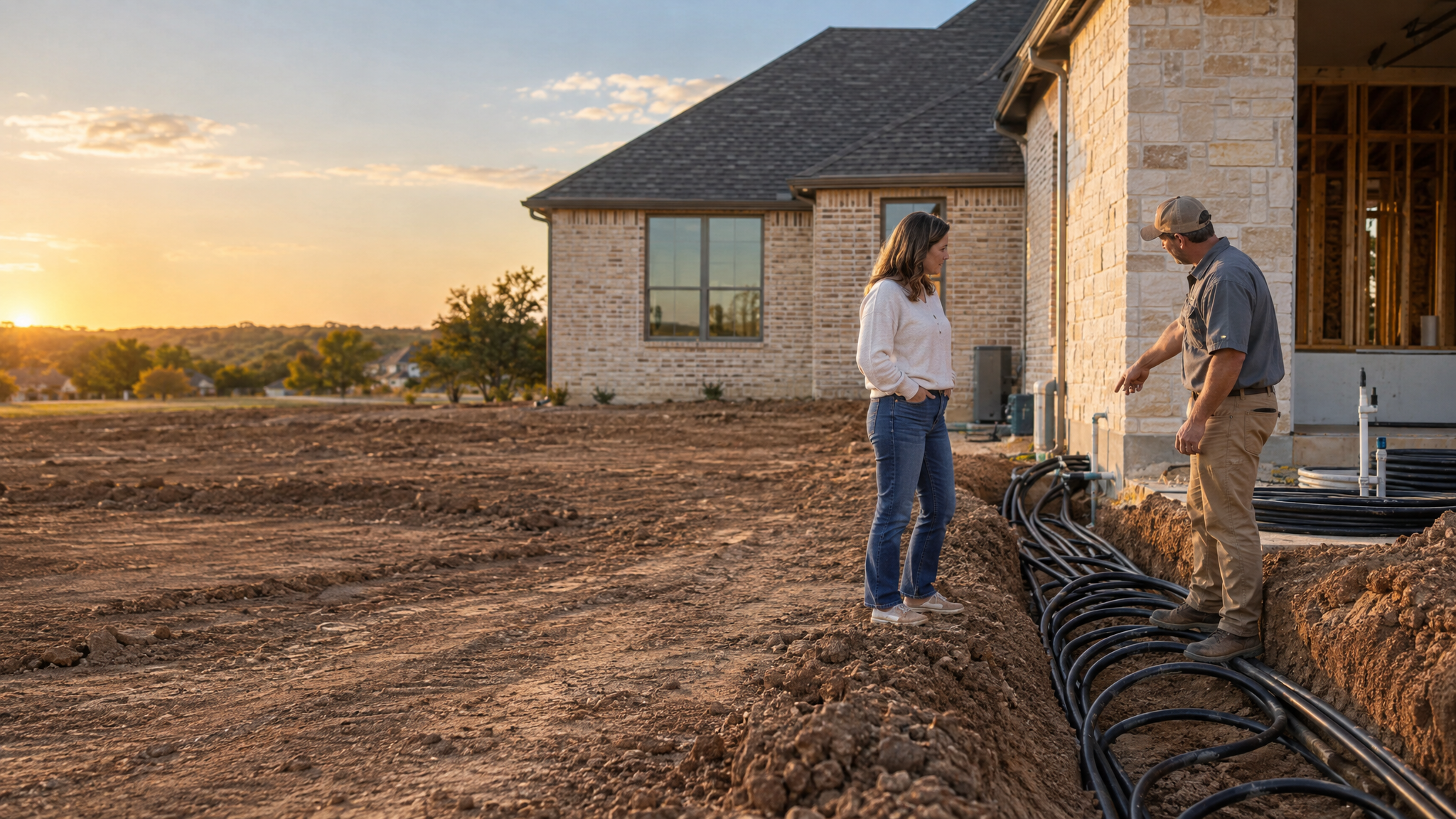
Why Geothermal Fits the North Texas Climate
Dallas summers regularly push past 100°F, and a conventional air conditioner has to dump your home's heat into that hot outdoor air. A geothermal system is ground-coupled: it transfers heat between your home and the earth instead.
In North Texas, temperatures roughly 15–30 feet underground are much steadier than outdoor conditions in both summer and winter. That stable underground temperature is the fundamental efficiency advantage.
What's Actually Installed
• Ground loop — piping buried in trenches or drilled boreholes that exchanges heat with the earth.
• Indoor heat pump — replaces the traditional furnace/outdoor condenser combination.
• Air or water distribution — usually ductwork that carries conditioned air through the home.
The indoor pieces are similar in scale to conventional HVAC equipment. The ground loop is what makes geothermal different — and it's the part that benefits most from being planned early.
Why New Construction Is the Best Moment
On a new build, the heavy site work is already happening. Trenching, drilling, grading, and foundation work can be coordinated so the loop goes in before the slab, driveway, landscaping, and other finished surfaces.
Adding a loop to an existing, fully landscaped home means digging up yards and working around structures that are already in place. That's why the new-construction advantage is really about installing the underground infrastructure while the site is already being excavated — not simply about the age of the house.
The U.S. Department of Energy makes a similar point: horizontal loop installation is commonly the most economical residential approach during new construction when there's adequate land.
Large Lots vs. Infill Lots
Builders tend to match the loop to the lot:
• Larger lots — horizontal loops laid in trenches are often practical and cost-effective.
• Smaller infill lots — vertical loops placed in drilled boreholes use far less yard area.
Choosing the right layout during design keeps disruption low compared with a retrofit. See our loop types guide for a closer look at each option.
When Geothermal May Not Make Sense
Geothermal doesn't automatically make sense for every Dallas new build. Site area, soil and drilling conditions, lot layout, local permitting, upfront budget, utility pricing, and the quality of the HVAC and loop design all affect whether it's the right choice.
If you're a homeowner, builder, or buyer weighing geothermal for a new home, tell us about the project. Climate Codes can connect you with a DFW provider experienced in geothermal design and installation — even if you're not sure yet which system you want.