The Core Idea: Move Heat, Don't Make It
A conventional air conditioner pushes your home's heat into the outdoor air — which, on a 105°F Dallas afternoon, is already very hot. A geothermal system does the same job, but it exchanges heat with the ground instead.
A few feet below the surface, the earth isn't swinging between summer highs and winter freezes the way the air does. The U.S. Department of Energy (DOE) notes that shallow-earth temperatures typically stay between about 40°F and 70°F. Rejecting heat into ground that's cooler than the summer air — and pulling heat from ground that's warmer than the winter air — is what gives geothermal its efficiency advantage.
Summer vs. Winter Operation
In summer, the system collects heat from inside your home and carries it into the ground, which acts as a heat sink.
In winter, the process reverses: the system draws heat from the ground (a heat source) and delivers it indoors.
Because the same equipment handles both jobs, one geothermal system replaces a separate furnace and air conditioner. Some systems can also help with domestic hot water.
The Three Main Parts of a Geothermal System
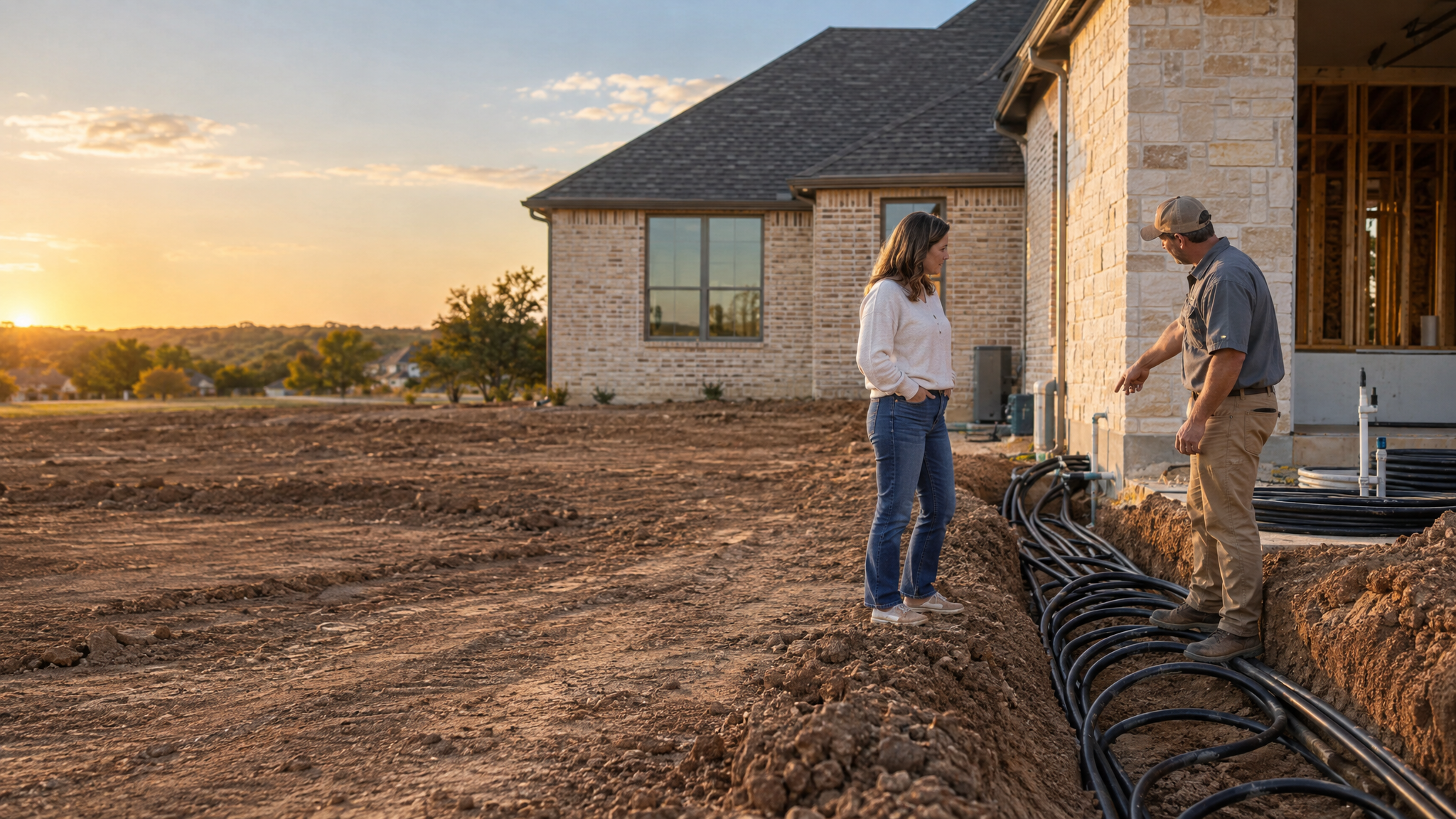
• Ground loop — buried or submerged piping that exchanges heat with the earth (or a suitable body of water).
• Indoor heat pump — the equipment inside the home that moves heat between the loop and your living space.
• Distribution system — ductwork (or, in some homes, water-based distribution) that delivers the heated or cooled air throughout the house.
We cover the different ways the ground loop can be laid out in our guide to geothermal loop types.
Geothermal Beyond a Single House
The same principle scales up. The DOE and the National Laboratory of the Rockies describe geothermal district heating and cooling systems and thermal energy networks, where multiple buildings — a campus, a military base, or a whole neighborhood — share an underground pipe network and heat-pump infrastructure.
The National Laboratory of the Rockies also notes that geothermal heat pumps can serve space heating, cooling, and domestic hot water while reducing building energy use and peak electrical demand compared with traditional HVAC systems. That peak-demand benefit is one reason planners and developers are paying attention to networked geothermal.
Is It Right for Every Home?
Not automatically. Lot size, soil and drilling conditions, local permitting, upfront budget, utility rates, and — above all — the quality of the loop and HVAC design all affect whether geothermal is a good fit. The best way to find out is to have an experienced geothermal provider look at your specific site.